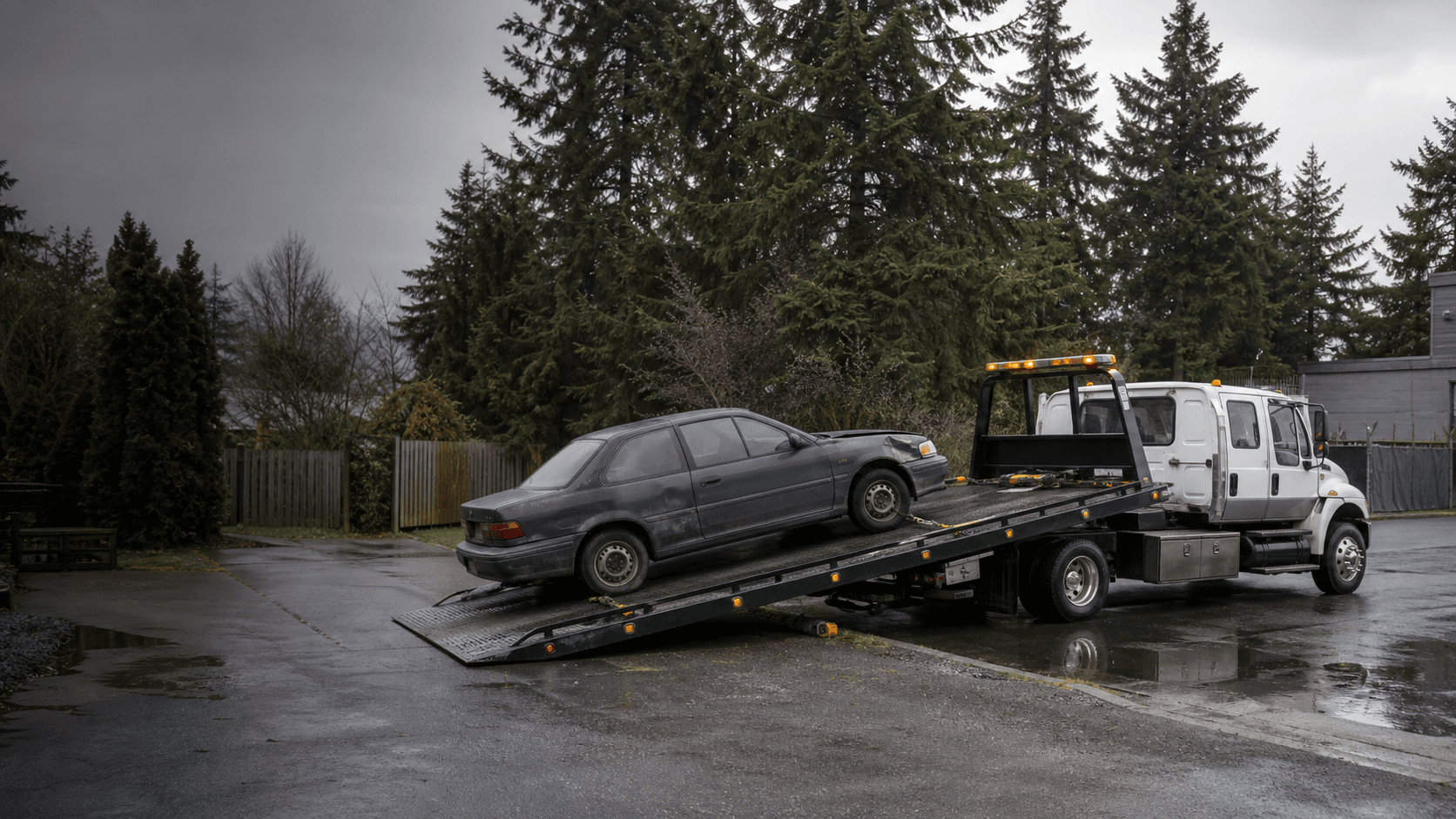
If you are reading this, the decision is made and a truck is coming. This page is not here to talk you into anything; it is here so the pickup does not fail.
Most of what you will read elsewhere about preparing a car is generic tidying advice. The parts that actually cause a pickup to collapse on the driveway are specific, and in Oregon most of them come from rules the driver has to follow whether they want to or not.
The short version: a licensed dismantler cannot take your car without the ownership document, and cannot complete the check they are required to do if they cannot reach the VIN. Everything else on this page is smaller than those two.
QUICK ANSWER
Have the ownership document physically present, not promised — Oregon defines a dismantler acquiring a vehicle as having possession of the car and its ownership record together. Make sure the windshield VIN is reachable and readable, because the driver has to match it against that document. Decide about the plates before the truck comes, since a dismantler records the number and then destroys them. Empty the car completely, because you will not see it again. And know that this is one-way: once the dismantler files their notice with DMV, the vehicle cannot be titled again.
01
The document, and why a promise will not do
This is the reason most pickups fail, and it is not the driver being difficult.
Oregon's handbook for dismantlers defines acquiring a vehicle as having physical possession of it, and its ownership record, together. Not one then the other. A driver who takes your car without the document has not acquired it in the sense their license requires, and their own records — which they must keep for three years and produce for DMV or a police officer — will not add up.
So "I will post the title tomorrow" is not a workaround, and a driver who refuses it is doing their job. Have the title, or whatever release of interest applies to your situation, physically in your hand when the truck arrives.
If the title is lost, or the car is not in your name, sort that before booking a pickup rather than on the day. Those are different problems with different answers, and both take longer than a phone call.
02
The VIN has to be reachable, not just present
This one almost nobody mentions, and it is the most common avoidable failure.
The driver is required to verify that the VIN on the vehicle matches the VIN on the ownership document. DMV's guidance is more specific about WHICH VIN: it calls it best practice to complete that verification on the public VIN or the frame VIN whenever possible, and says it is not advisable to view the VIN only in a commonly removed or replaced part of the vehicle, such as a door or a hood.
In practice that means the plate at the base of the windshield, driver's side. Which means it has to be reachable and readable.
A car reversed hard against a fence, buried under a tarp and a decade of blackberry, with a windshield you cannot see through, is a car the driver cannot legally check. Ten minutes with a bucket of water and some pruning shears the day before is the difference between a completed pickup and a rescheduled one.
If the VIN plate is genuinely missing or unreadable, say so when you book rather than letting the driver discover it. It is a solvable problem in advance and a wasted trip on the day.
- Clear whatever is blocking the base of the windshield, driver's side
- Clean the glass over the VIN plate if it is dirty
- Check the number is legible in daylight before the truck comes
- Tell the buyer in advance if the plate is missing or damaged
03
The plates, and what actually happens to them
Oregon DMV says you may remove your plates before selling, and ORS 803.530 otherwise leaves plates with the vehicle they are assigned to. So this is a decision, not a rule, and anyone who tells you the plates automatically belong to you is overstating it.
For a car going to a dismantler, though, the decision is easy once you know what happens next. The handbook tells a dismantler to record the plate number, remove the plates from the vehicle, and then destroy them on receipt of the ownership document — cut or defaced so they cannot be reused, with the stickers scraped off and the registration card destroyed too.
So if you want to keep a plate, transfer it to another vehicle, or simply have it, take it off before the truck arrives. Nothing about that is sentimental: it is the last moment it exists.
04
Empty it as though you will never see it again, because you will not
Every tow operator has the same collection of stories, and they are all the same story: the thing that was in the trunk.
Glovebox, trunk, under and behind the seats, the door pockets, the spare wheel well, the sun visor, and the center console. Garage door remotes and toll transponders especially, because both keep working for whoever ends up with them. Insurance documents and anything with your address on it, for the same reason.
Take the registration card if it is in the car, since it is going to be destroyed anyway.
This is worth doing properly rather than quickly, because a junk vehicle does not sit in a lot waiting for you to remember. It is processed.
05
What the truck actually needs from your driveway
A non-running car is towed or winched, not driven, and that changes what matters.
Space to work. A flatbed needs room to park, tilt the deck, and pull the car straight back. A tight driveway with a car parked behind is a longer job or an impossible one. Move whatever else is in the way the night before.
A straight-ish pull. Winching around a corner is possible and slow. If the car is somewhere awkward — behind a house, on grass, in a carport with a low roof — say so when you book, and be specific. "It is round the back on gravel, about forty feet from the street" gets the right truck sent. "It is at my house" does not.
Wheels that turn, or a warning that they do not. A car that rolls is straightforward. A car with seized brakes, flat tires or a missing wheel needs different equipment, and that has to be known in advance.
Keys if you have them. They help, mostly for steering and releasing the parking brake. They are not essential, and no honest buyer should reduce an offer at the door because keys are missing when you said in advance that they were.
Clear the low branches. A flatbed is taller than you think.
06
This is one-way, and it is worth knowing before the truck comes
This is the part of the process people learn afterwards, and it deserves to be said plainly.
Within 30 days of acquiring the vehicle, an Oregon dismantler must send DMV a Vehicle Dismantler's Notice, Form 735-270, together with the title or other ownership document. Filing it certifies the vehicle was dismantled, destroyed or sold on to another dismantler.
The consequence is permanent. DMV adds an "In Dismantler Stock" indicator to the vehicle record, and DMV will reject subsequent applications for title. The handbook allows removal of the indicator only in narrow circumstances, essentially where the dismantler certifies the notice was filed in error and amends their reporting.
So the last useful moment to change your mind is before the vehicle leaves. Once the process runs, it is not a sale you can unwind by buying the car back — as far as the record is concerned, the vehicle is gone.
07
After it goes
Two things, and neither takes long.
File the notice of sale within ten days. It is what tells DMV the vehicle is no longer yours, and until it exists the record still points at you. It is the cheapest protection in the whole transaction.
Keep your copy of everything. The release you signed, the buyer's details, the date, and the plate number if you noted it. If a question ever arises about when the car stopped being yours, that file is the answer.
Then cancel the insurance, and not before — a vehicle sitting on your property is still worth covering until it is actually gone.
08
What is Oregon-specific here, and what is not
Worth being straight about, because a lot of pages imply that everything on them is a local rule.
The physical preparation is universal. Clearing a path, emptying the car, warning about a low carport, finding the keys — a tow operator in any state wants the same things, and none of it comes from Oregon law.
The paperwork and the consequences are specifically Oregon's. That a dismantler must have the car and its ownership record together, that they must match a VIN they can actually reach, that your plates get destroyed rather than filed away, that Form 735-270 makes the vehicle untitleable, and that your notice of sale is due in ten days — those are the rules that decide whether the day works.
Which is a useful way to read any advice on this subject: the tidying is the same everywhere, and the parts that can actually go wrong are local.
FREQUENTLY ASKED QUESTIONS
What do I actually need on the day of pickup?
The ownership document physically present, a VIN the driver can reach and read, and the vehicle accessible to a truck. Oregon defines a dismantler acquiring a vehicle as having possession of the car and its ownership record together, so the document is not optional and cannot follow later.
Can the driver take the car if I post the title afterwards?
No, and a driver who refuses is doing their job. The rule requires possession of the vehicle and the ownership record together, and a dismantler has to keep records that stand up to inspection by DMV or a police officer for three years.
Why does the VIN matter so much?
Because the driver must verify that the VIN on the vehicle matches the one on your document, and DMV calls it best practice to do that on the public or frame VIN rather than a door or hood sticker. If the windshield plate is buried or unreadable, the check they are required to make cannot be done.
My car is buried under a tarp and blackberry. Does that matter?
Yes, more than people expect. Clear the base of the windshield on the driver's side so the VIN plate is visible and legible, and clear a path for the truck. Ten minutes the day before is the difference between a completed pickup and a rescheduled one.
Should I take the license plates off?
For a car going to a dismantler, yes, if you want to keep or transfer them. DMV says you may remove your plates before selling and ORS 803.530 otherwise leaves them with the vehicle, so it is a choice — but a dismantler records the number and then destroys the plates and the registration card. Once the truck leaves, they are gone.
Do I need the keys?
They help with steering and the parking brake, but they are not essential for a towed vehicle. Say in advance if you do not have them. An honest buyer prices that when quoting, not at your door.
What if the wheels will not turn?
Say so when you book. Seized brakes, flat tires or a missing wheel need different equipment, and a truck sent for a rolling car may not be able to take one that does not roll. It is a scheduling problem in advance and a wasted trip on the day.
The car is behind the house on grass. Is that a problem?
Not necessarily, but be specific when you book. "Round the back on gravel, about forty feet from the street" gets the right truck sent; "at my house" does not. Winching around a corner is possible and slower, and low carport roofs and overhanging branches matter more than people think.
Can I change my mind after the car is collected?
Practically, no. Within 30 days the dismantler files a Vehicle Dismantler's Notice, Form 735-270, with your title, and DMV then adds an "In Dismantler Stock" indicator and rejects subsequent applications for title. The last useful moment to change your mind is before the vehicle leaves.
What should I take out of the car?
Everything. Glovebox, trunk, under and behind the seats, door pockets, spare wheel well, sun visor and console. Garage door remotes and toll transponders especially, since both keep working for whoever has them, along with anything showing your address.
When should I cancel the insurance?
After the vehicle has actually gone, not before. While it is still on your property it is worth covering. File the notice of sale within ten days, which is what tells DMV it is no longer yours.
Is any of this specific to Oregon?
The physical preparation is not — clearing access and emptying the car is the same anywhere. The paperwork is: the ownership document requirement, the VIN check, the destruction of your plates, Form 735-270 making the vehicle untitleable, and the ten-day notice of sale are Oregon rules, and they are the parts that decide whether the day works.
PRACTICAL CHECKLIST
The night before
- Put the ownership document somewhere you will not have to look for it
- Clear access to the windshield VIN and check it is readable
- Take the plates off if you want to keep or transfer them
- Empty the glovebox, trunk, console, door pockets and under the seats
- Take the garage remote and any toll transponder
- Move whatever is blocking the truck's path
- Note whether the wheels turn, and tell the buyer if they do not
- Find the keys if you have them, and say so in advance if you do not
JUNK-CAR SERVICE AREAS FOR THIS GUIDE
- Sell a Junk Car in PortlandPortland pickup, access checked when you book.
- Sell a Junk Car in SalemSalem collection for long-parked cars.
- Sell a Junk Car in EugeneEugene pickup, towing on an accepted offer.
- Sell a Junk Car in BendBend collection arranged around access.
- Sell a Junk Car in MedfordMedford pickup in any condition.
- Sell a Junk Car in BeavertonBeaverton collection, free of charge.
- Sell a Junk Car in GreshamGresham pickup for non-running vehicles.
- Sell a Junk Car in Oregon CityOregon City collection with a flatbed.
USEFUL OREGON RESOURCES
- How to Sell a Junk Car in OregonThe whole process, of which pickup is the last step.
- Oregon DMV Notice of Sale: the 10-Day ChecklistThe filing that ends your connection to the vehicle.
- How to Check an Oregon Junk Car BuyerWorth reading before you book, not after.
- Oregon DMV Handbook, Chapter P: DismantlersThe rules the driver is working to, including Form 735-270.
OFFICIAL SOURCES
Rules, forms, fees, and program eligibility can change. Use these primary sources to confirm your situation.
- Oregon DMV Title and Registration Handbook, Chapter P: Dismantlers
- Oregon DMV: Buying or Selling a Vehicle
- ORS 803.530: Registration Plates — Validity and Transfer
- OAR 735-020-0075: Release or Assignment of Interest
Prepared and reviewed on September 8, 2026 against Chapter P of the Oregon DMV Title and Registration Handbook, DMV's Buying or Selling a Vehicle page, ORS 803.530 and OAR 735-020-0075. Rules and forms change; confirm current requirements on Oregon.gov. General information for vehicle owners, not legal advice. This is a practical page for someone who has already decided to sell and is waiting for a truck.
Reviewed by CashMyCarOregon Editorial Team: Oregon seller-document research and editorial review
