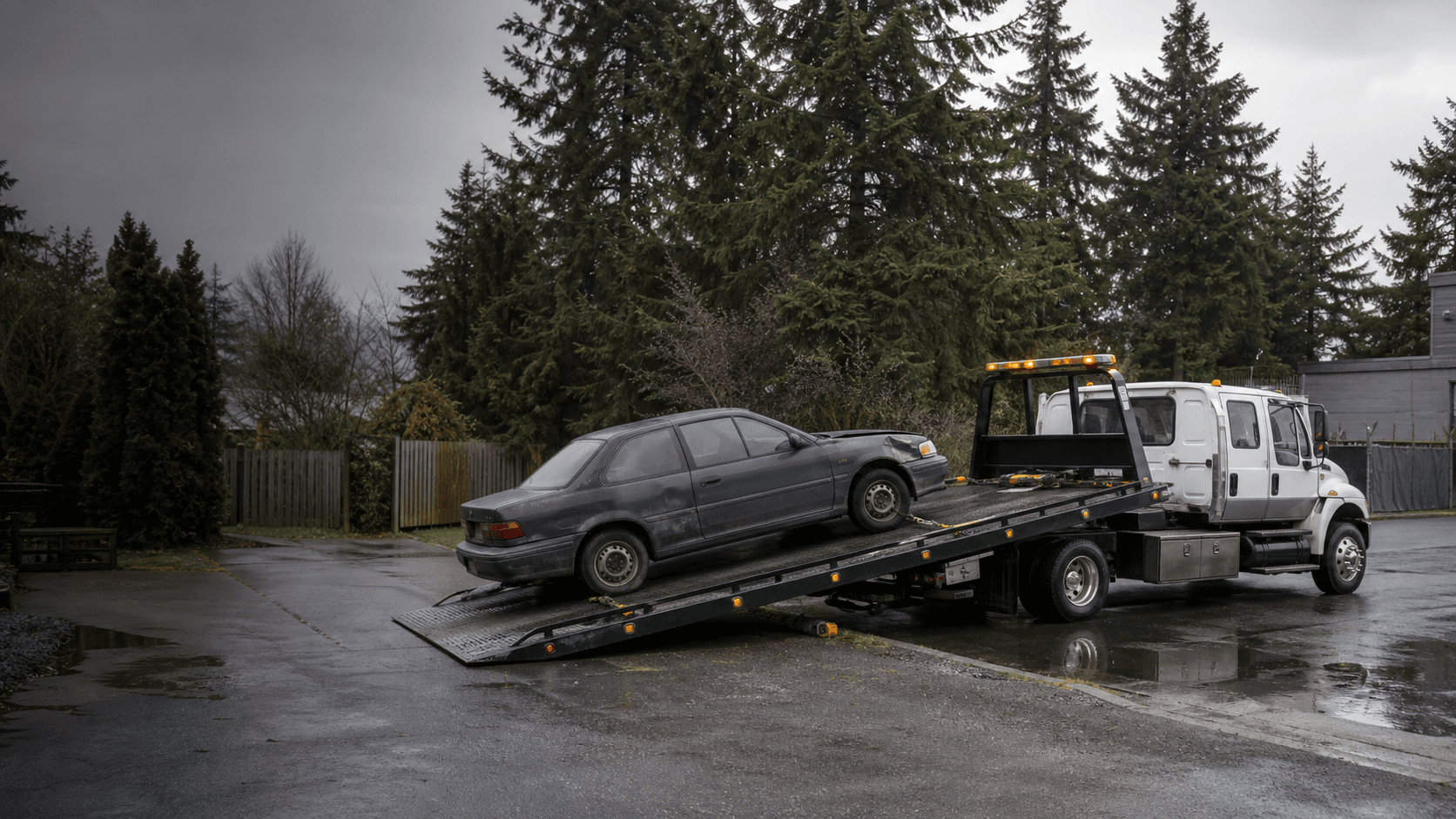
Selling a junk car in Oregon is mostly paperwork. The vehicle's condition barely matters to the state; what matters is whether the person handing it over is entitled to, and whether the transfer is recorded properly afterwards.
Most of the guides that rank for this search are national templates with a city name dropped in. They tell you to gather your documents and get quotes. They do not tell you which Oregon form to use, what the odometer rule actually says, what happens if your name is not on the title, or how many cars you can sell before Oregon DMV starts treating you as an unlicensed dealer.
This guide covers the whole sequence with the specifics attached, and it is honest about the two places where sellers most often get stuck: no title, and more vehicles than the exemption comfortably covers.
QUICK ANSWER
Oregon requires four things from a seller. Sign and date either the back of the title or a bill of sale; make sure any lienholder has signed the front of the title or given a separate signed release; record the odometer on the back of the title if the vehicle is model year 2011 or newer and under 20 years old; and notify DMV of the sale within 10 days using DMV2U or Form 735-6890, including the buyer's name and address.
01
What Oregon actually requires from you, in four items
Strip away the advice and Oregon DMV's seller instructions come down to a short list. DMV's buysell page gives three steps and the 10-day notice; everything else in this guide is detail on one of those four. Keeping your own records is not on DMV's list. We recommend it anyway, and say so as our advice rather than Oregon's.
You sign and date either the back of the title or a bill of sale. If there was a loan, the lienholder signs the front of the title or provides a separate signed statement releasing their interest. If the vehicle is model year 2011 or newer and under 20 years old, you write the odometer reading on the back of the title and both you and the buyer sign it. You keep the paperwork. And you tell DMV within 10 days that you sold it, including the buyer's name and address.
One consequence deserves emphasis because it surprises people: DMV notes the sale on your record, but you stay listed as the owner until the buyer transfers the title. Your 10-day notice is what proves when the vehicle left you. It is not the same thing as the title moving.
- Sign and date the back of the title, or a bill of sale
- Lienholder signs the front of the title, or gives a separate signed release
- Odometer on the back of the title if 2011 or newer and under 20 years old
- Notify DMV within 10 days with the buyer's name and address
02
Step 1: Confirm you are actually allowed to release the car
Start at the vehicle rather than the paperwork. Read the VIN from the dashboard or the door label and compare it, digit by digit, with the VIN on the title. Transposed characters are common and they stop a transfer dead.
Then read the ownership line carefully. Oregon does not print a connector between owner names. What it prints is a survivorship box, shown as Y/N, Y/Y, N/N or N/Y, and that box is about what happens when an owner dies rather than who signs a sale. So do not go looking for an "and" or an "or" to tell you who must sign. DMV tells buyers to make sure that all owners shown on the title, including any lienholders, have released interest; the seller's side of that is simple. Every named owner releases.
Check for a security interest holder as well. A lender who was paid off years ago can still be printed on the title, and that has to be released before ownership can move.
If your name is not on the title at all, stop here. That is a different problem, and no amount of paperwork between you and a buyer solves it. Depending on the situation you may need a replacement title, a release from the person actually on the title, or an inheritance path.
- VIN on the vehicle must match the VIN on the title
- Every named owner releases; check the survivorship box, not a connector
- A paid-off lender can still be printed on the title
- If your name is not on it, resolve ownership first
03
Step 2: The odometer rule, and the trap inside it
Oregon DMV's rule is specific: if the vehicle is model year 2011 or newer and under 20 years old, you must record the odometer reading on the back of the title, and both you and the buyer must sign it.
Both conditions matter. A 2011 vehicle is inside the window today; a 2004 vehicle is not, because it fails the model-year test. Read it as a window rather than a single cut-off, and check where your vehicle sits before assuming the requirement does not apply.
The trap is what happens when the title is missing for a vehicle inside that window. DMV is explicit: get a replacement title before selling. You cannot disclose mileage on a document you do not have, and the requirement is federal rather than a DMV preference, so no buyer can waive it for you.
Do not guess the reading and do not write "unknown" to save a trip. An inaccurate disclosure is a problem attached to your signature.
04
Step 3: Sign the title — or use a bill of sale correctly
The ordinary route is signing and dating the back of the title. The alternative Oregon allows is a bill of sale, and this is where sellers get sloppy in a way that costs the buyer a rejected application.
You may use DMV's own Vehicle Bill of Sale, Form 735-501, or a separate document containing the same information. DMV states what that information is, and says it cannot process a bill of sale without it: the VIN, a statement releasing interest in the vehicle, the printed name of the seller or sellers, the seller's signature or signatures, and the date of sale.
Write all five in every time. A handwritten note saying "sold as seen" with a signature is not a bill of sale in DMV's sense, and it will come back.
One thing a bill of sale cannot do is stand in for authority you do not have. It records that a transaction happened. It does not replace a missing title, clear a lien, resolve a deceased owner, or remove a title brand.
- DMV Form 735-501, or a document with the same five elements
- VIN, release statement, printed seller name, seller signature, date of sale
- DMV cannot process a bill of sale missing any of these
- It never substitutes for authority you do not have
05
Step 4: Agree the offer, then the pickup
With ownership settled, the transaction itself is straightforward. Expect a buyer to ask for the year, make, model, VIN, whether it starts and drives, whether it rolls and steers, what is missing, where it is parked, and how a truck would reach it.
Answer those accurately, including the unflattering parts. An offer built on a description that turns out to be wrong gets revised at the kerb, which is exactly the situation nobody wants. Missing catalytic converter, no wheels, sunk into soft ground, behind a locked gate: say so at the offer stage and the price you are quoted is the price that holds.
Agree the access details before the day. Narrow driveway, no key, flat tyres, a car that has not moved in years and may have seized brakes — a tow operator can handle all of it, but not if they arrive expecting to winch something that rolls.
Have your identification and the paperwork physically present at pickup. A legitimate buyer completes the documents at the vehicle, not afterwards by email.
06
Step 5: Notify DMV within 10 days, and why it protects you
This is the step people skip, and it is the one that protects you after the car is gone.
Notify DMV of the sale within 10 days using DMV2U online, or Form 735-6890, the Notice of Sale or Transfer. Include the buyer's name and address; the notice is much weaker without them.
What it does and does not do is worth being precise about. DMV notes on your record that you sold the vehicle. You remain listed as the owner until the buyer applies to transfer the title. The notice is your dated evidence of when the vehicle stopped being yours, which is what you produce if a parking citation, a tow bill, or a question about the vehicle arrives months later.
Save the confirmation. A screenshot of the DMV2U confirmation, filed with the signed release and the buyer's details, is a complete answer to almost any question that can arrive afterwards.
On plates: DMV says you may remove your licence plates before selling. It is not framed as mandatory for every sale, but removing them is the safer habit, because plates left on a vehicle you no longer control can attract citations in your name.
- DMV2U or Form 735-6890, within 10 days
- Include the buyer's name and address
- You stay listed as owner until the buyer transfers title
- Keep the confirmation with the rest of the file
- You may remove your plates; it is the safer habit
07
Can you sell a car in Oregon without a title?
Sometimes, and the honest answer depends on which of three situations you are in.
The title is lost but you are the recorded owner. Apply for a replacement using Form 735-515. For a vehicle inside the odometer window, DMV says the seller must get a replacement title so the reading can be disclosed on the back of the new one. DMV does not put a deadline on it, but doing it before the sale is the order that works, because the disclosure belongs on a title you do not yet have. Replacement titles are among DMV's faster transactions, so this is usually a short delay rather than a dead end.
Your name is not on the title. A bill of sale from you does not transfer what you do not hold. You need a release from the person actually on the title, or, where someone has died, the appropriate inheritance route.
The vehicle is too far gone for DMV to title at all. This is specific to junk vehicles and worth knowing: Oregon DMV states it cannot issue a title for some damaged vehicles. If that is your car, the path is a dismantler or a buyer who handles vehicles under those rules, not a normal title transfer.
Local forum threads are full of buyers advertising "no title, no problem". Read that as a statement about how they intend to handle the paperwork, which is to say not at all. A buyer indifferent to whether they can title the vehicle is a buyer who will leave your name attached to it.
08
How many cars can you sell in Oregon without a dealer certificate?
This question gets answered badly almost everywhere, usually as a flat "five per year". The statute says something more precise and more useful.
Acting as a vehicle dealer without a certificate is an offence under ORS 822.005. ORS 822.015 then lists the exemptions, and the one covering ordinary people is the owner of a vehicle shown on the title who owned it primarily for personal, family or household purposes.
Here is the part the summaries miss. The statute says that if a person has sold, traded, displayed or offered for sale more than five vehicles in one calendar year, that person carries the burden of proving the vehicles were owned primarily for personal, family or household purposes.
So five is not a hard allowance and the sixth sale is not automatically illegal. What changes at that point is who has to prove what. Below the line the exemption sits comfortably with you. Above it, you are the one who must demonstrate the vehicles were genuinely personal, and "sold, traded, displayed or offered" is broader than completed sales, so listings count.
For nearly everyone clearing one dead car off a driveway this is academic. It matters if you are working through several vehicles from an estate, a property clearance, or a hobby that got out of hand. DMV's Business Regulation section investigates unlicensed dealing, referred to as curbing, so if you are near or past that line it is worth a call to DMV rather than a guess.
Note also that the calendar-year count is one exemption among several in ORS 822.015. Others cover receivers and personal representatives, lienholders foreclosing possessory liens, and people restoring vehicles for their own use. If your situation is unusual, read the section rather than the summaries.
- ORS 822.005 makes uncertified dealing an offence
- ORS 822.015(1)(b) exempts personal, family or household ownership
- Past five vehicles in a calendar year, the burden of proof shifts to you
- "Sold, traded, displayed or offered" is broader than completed sales
- DMV Business Regulation investigates curbing; call if you are near the line
09
What a legitimate buyer will and will not ask for
Threads on local forums show real suspicion of junk-car buyers, and much of it is earned. A few markers separate a business that intends to title the vehicle from one that does not.
A legitimate buyer asks for proof that you can sell: the title in your name, or a documented path to it. They complete the paperwork at the vehicle. They give a firm offer based on an accurate description and hold it. They arrive with a tow operator equipped for the actual conditions. They take the buyer details you need for your DMV notice.
A buyer to walk away from asks you to sign a blank title, tells you the title does not matter, wants you to sign as owner when you are not, sends a payment for more than the agreed amount and asks you to refund the difference, or pressures you to release the vehicle before payment has genuinely cleared.
You are entitled to slow down. The car has probably sat for months; another day to get the paperwork right costs you nothing.
10
If your situation is not the standard one
Most complications have a specific answer rather than a general one, and several deserve their own guide.
If there is still a loan on the vehicle, or it was totalled while financed, the payoff sequence comes before anything else. If the title is lost, start the replacement now rather than at pickup. If the car will not run, has a blown engine or a failed transmission, or has body damage, condition affects the offer but not the paperwork. If the registration has expired, that is separate from the title and does not by itself prevent a sale. If you are weighing donating instead of selling, or repairing instead of either, those are decisions with different arithmetic.
The links below go to the guide for each of those situations. They are all Oregon-specific and all written for the same audience as this page.
11
The whole thing, in order
If you read nothing else, this is the sequence. Confirm the VIN matches and that every owner and lienholder on the title can release interest. Resolve a missing title or an unreleased lien before agreeing a pickup date. Describe the vehicle and its access honestly and take a firm offer. Complete the odometer disclosure if the vehicle is model year 2011 or newer and under 20 years old. Sign the title, or a bill of sale carrying all five required elements. Hand over the vehicle and take payment. Remove your plates. Notify DMV within 10 days with the buyer's name and address. Keep the whole file.
CashMyCarOregon buys vehicles in any condition, with towing included on an accepted offer inside the confirmed service area, and we will tell you which of the paths above applies to your vehicle before we schedule a truck rather than after. If something in your ownership situation is unusual, say so when you request the offer; it is nearly always fixable, and it is always cheaper to fix before the tow than during it.
FREQUENTLY ASKED QUESTIONS
How do you privately sell a car in Oregon?
Sign and date the back of the title or a bill of sale, make sure any lienholder has released interest on the front of the title or in a separate signed statement, complete the odometer disclosure if the vehicle is model year 2011 or newer and under 20 years old, then notify DMV of the sale within 10 days using DMV2U or Form 735-6890 with the buyer's name and address.
How many cars can you sell in Oregon without a dealer licence?
There is no flat allowance. ORS 822.015 exempts an owner who held the vehicle primarily for personal, family or household purposes, but if you have sold, traded, displayed or offered more than five vehicles in one calendar year, you carry the burden of proving they were personal. The sixth sale is not automatically illegal; what changes is who must prove what.
What forms do I need to sell my car in Oregon?
Usually the title itself, plus Form 735-6890 or DMV2U for the sale notice. If you use a bill of sale, DMV Form 735-501 or a document with the same information. If the title is lost, Form 735-515 for a replacement. Odometer disclosure is recorded on the back of the title where it applies.
Can I sell a car in Oregon without a title?
It depends. If the title is lost and you are the recorded owner, apply for a replacement first. DMV says the seller must get one for a vehicle in the odometer window, and doing it before the sale is practical rather than required. If your name is not on the title, you need a release from whoever is. And Oregon DMV cannot issue a title for some damaged vehicles at all, in which case the route is a dismantler rather than a title transfer.
What does the odometer rule actually say?
If the vehicle is model year 2011 or newer and under 20 years old, the odometer reading goes on the back of the title and both you and the buyer sign it. Both conditions apply, so read it as a window rather than a single cut-off. If the title is missing for a vehicle in that window, get a replacement before selling.
What has to be on an Oregon bill of sale?
DMV states it cannot process one without the VIN, a statement releasing interest in the vehicle, the printed name of the seller or sellers, the seller's signature or signatures, and the date of sale. You can use DMV Form 735-501 or any document containing the same information.
Am I still the owner after I notify DMV of the sale?
On the record, yes, until the buyer applies to transfer the title. DMV notes that you sold the vehicle, but you remain listed as owner until the transfer happens. That is exactly why the 10-day notice matters: it is your dated evidence of when the vehicle left you.
Should I remove my licence plates before the car is towed?
DMV says you may remove them before selling, and it is the safer habit. Plates left on a vehicle you no longer control can attract citations in your name before the buyer completes the transfer.
Do I need to clean the car or drain the fuel before pickup?
No. Remove personal belongings, decide about the plates — DMV says you may remove them — and hand over the keys if you have them. Condition does not change the paperwork. What does matter is describing access accurately, because a tow operator needs to arrive with the right equipment.
What if the car has not moved in years and will not roll?
Say so before the offer rather than on the day. Seized brakes, flat tyres, missing wheels, soft ground and locked gates are all workable with the right truck, but only if the operator knows in advance. An accurate description is what keeps a quoted price from being revised at the kerb.
Is a buyer who says "no title, no problem" legitimate?
Treat it as a warning. A buyer indifferent to whether they can title the vehicle is telling you they do not intend to complete the transfer, which leaves your name attached to the car. Citations and tow bills can follow months later.
How fast can a junk car actually be sold in Oregon?
If the title is clean and in your name, quickly. The delays come from paperwork rather than logistics: a lost title, an unreleased lien, or an owner who cannot be reached to sign. Resolve those first and the sale and tow happen in a single step.
PRACTICAL CHECKLIST
Oregon junk-car seller checklist
- Match the VIN on the vehicle to the VIN on the title
- Check whether owners are joined by "and" or "or"
- Clear any lienholder from the title, or get a signed release
- Get a replacement title first if it is lost and the car is 2011 or newer
- Complete the odometer disclosure if it applies
- Sign the title, or a bill of sale with all five required elements
- Describe condition and access accurately before the offer
- Take payment before the vehicle leaves
- Remove your licence plates
- Notify DMV within 10 days with the buyer's name and address
- File the confirmation with the signed release and payment record
JUNK-CAR SERVICE AREAS FOR THIS GUIDE
- Sell a Junk Car in PortlandFree Portland pickup once the title is clear.
- Sell a Junk Car in GreshamGresham collection in any condition.
- Sell a Junk Car in BeavertonBeaverton offers held while paperwork clears.
- Sell a Junk Car in HillsboroHillsboro pickup arranged around access.
- Sell a Junk Car in SalemSalem handoff with the DMV notice explained.
- Sell a Junk Car in EugeneEugene offers for long-parked vehicles.
- Sell a Junk Car in BendBend collection, towing on an accepted offer.
- Sell a Junk Car in MedfordMedford pickup for vehicles in any state.
USEFUL OREGON RESOURCES
- Oregon Vehicle Bill of Sale GuideWhat Form 735-501 must contain and when a bill of sale is enough.
- Oregon DMV Notice of Sale: 10-Day ChecklistFiling the notice that proves when the vehicle stopped being yours.
- Lost Car Title in OregonThe model-year rule and how to get a replacement before selling.
- Selling a Car With a Loan or Lien in OregonPayoff order, negative equity, and the release DMV accepts.
- Sell a Non-Running Car in OregonWhen the car will not start, roll or steer.
- Salvage, Totaled and Junk Titles in OregonWhat each title brand means, and why Oregon has no rebuilt title.
- Avoid Junk-Car Selling Scams in OregonThe buyer behaviour that should end the conversation.
- Oregon DMV: Buying or Selling a VehicleThe official seller instructions this guide follows.
- ORS 822.015: Dealer certificate exemptionsThe statute behind the five-vehicle burden-of-proof rule.
OFFICIAL SOURCES
Rules, forms, fees, and program eligibility can change. Use these primary sources to confirm your situation.
- Oregon DMV: Buying or Selling a Vehicle
- Oregon DMV: Vehicle Bill of Sale, Form 735-501
- Oregon DMV: Notice of Sale or Transfer, Form 735-6890
- Oregon DMV: Odometer Disclosure
- ORS 822.015: Exemptions from vehicle dealer certification requirement
Prepared and reviewed on September 8, 2026 against Oregon DMV's buying and selling instructions, DMV Forms 735-501 and 735-6890, DMV odometer disclosure guidance, and ORS 822.015 on exemptions from the vehicle dealer certificate requirement. Fees, forms and processing times change; verify current details on Oregon.gov before relying on them. This is general information for sellers, not legal advice. Confirm unusual ownership situations directly with Oregon DMV.
Reviewed by CashMyCarOregon Editorial Team: Oregon vehicle seller research and editorial review
