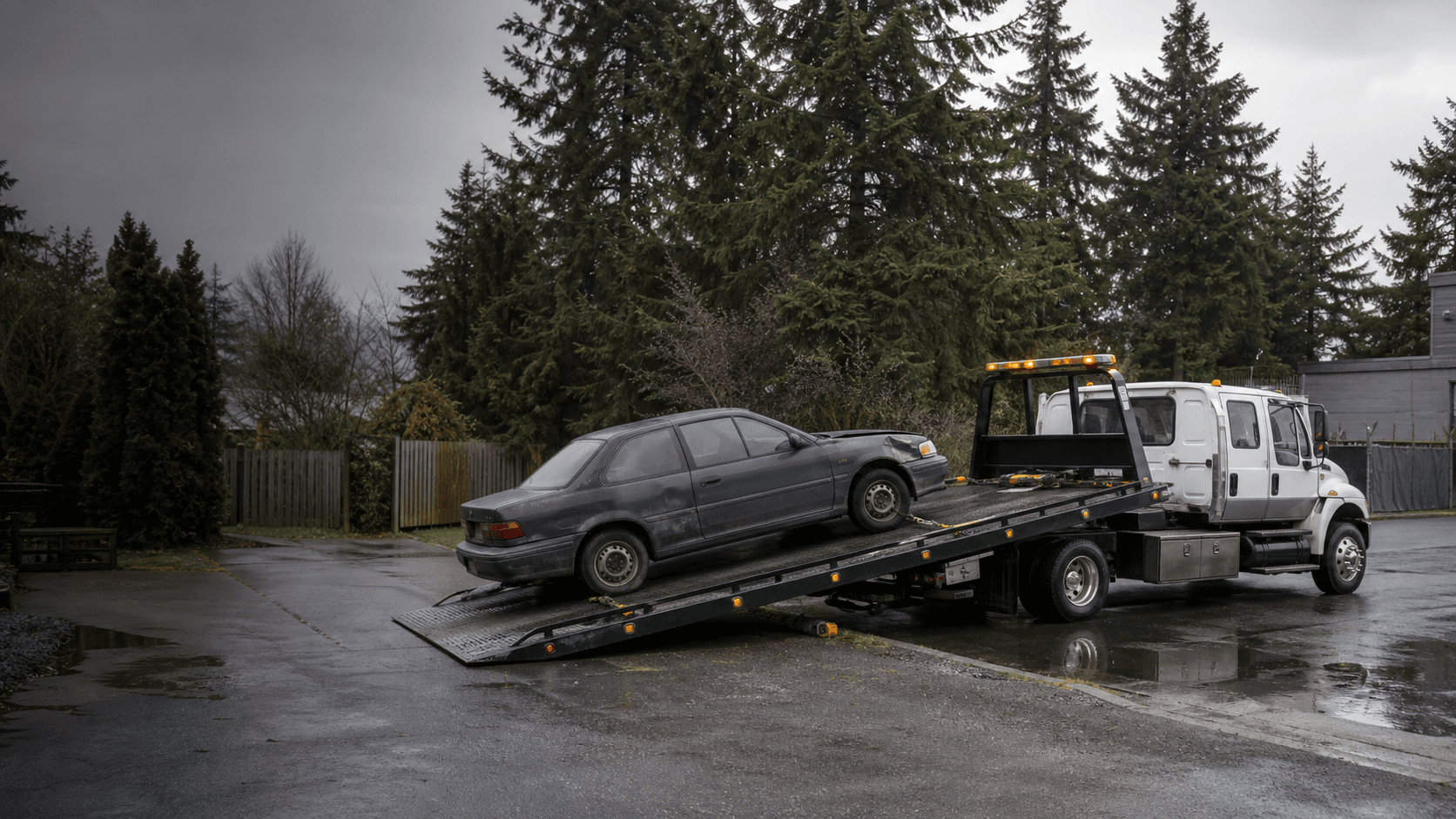
When someone dies, their car becomes a problem with a deadline attached. It is insured, registered and parked somewhere, and none of that stops while the family works out what to do.
Most guidance on this comes from estate lawyers, which means it is accurate and it starts at probate. Oregon has four routes, and the one people most often need does not involve a court at all. Knowing which one applies to you is usually the difference between an afternoon with a notary and a month of waiting.
There is also a question worth asking before any of them, because if the answer is yes, none of the four applies to you.
QUICK ANSWER
Oregon has four routes. If the title shows survivorship, the surviving co-owner needs only the death certificate. If there is no survivorship and no probate, heirs can use DMV's notarized Inheritance Affidavit, Form 735-516, with no court involvement. A simple estate affidavit under ORS 114.515 is filed with the probate court, carries a fee, and cannot be filed until 30 days after the death. Full probate produces Letters or a Decree of Final Distribution. Before any of them, check whether the deceased signed and dated a bill of sale before dying, because that release survives the death and takes the vehicle out of the estate entirely.
01
Ask this first, because it can end the whole question
Did the person who died sign anything releasing the vehicle before they died? A bill of sale, a signed title, a note that names the vehicle and says they were transferring it?
Oregon's rule is that a bill of sale is valid after the death of the person who released their interest, provided they signed and dated it before the death occurred. So if a parent sold or gave you the car three years ago and signed something at the time, that document did not lapse when they died. The interest was already released. The vehicle was never part of the estate, and none of the four routes below applies to you.
This is worth ten minutes of looking through paperwork before anything else, because the alternative can be a month's wait and a court fee. The test is the date on the document, not how informal it looks. What it must contain is set out in OAR 735-020-0075: the vehicle including the VIN, the full name and signature of the person releasing, the date, and a statement that the interest was sold, transferred, released or assigned.
Where this does not help is the far more common case: the owner died still holding the vehicle in their own name, having signed nothing. Then it is in the estate, and the rest of this page is about which route out of it you take.
02
Route one: the survivorship box
Look at the title before you look at anything else. Oregon titles carry a survivorship indicator for co-owners.
If the title shows survivorship, the surviving co-owner transfers it with the death certificates for the deceased co-owners and nothing more. No affidavit, no court, no heirs to gather. This is the cleanest outcome available and it is decided entirely by a box that was ticked years ago.
If the indicator shows no survivorship, or there was only ever one owner, the vehicle is in the estate and you continue to route two.
03
Route two: the DMV Inheritance Affidavit, and no courthouse
This is the route most competitors either omit or fold into the small-estate process, and the difference matters more than any other point on this page.
Where there is no survivorship and the estate is not being probated, a surviving heir uses DMV's Inheritance Affidavit, Form 735-516. It must be notarized and completed by each heir, and it goes to DMV with the application for title, the title fee, and the title if available — the phrase matters, because a missing title does not block this route.
There is no court filing, no probate case, and no statutory waiting period. This is a DMV transaction with a notary attached.
The catch is in the words "each heir". Every heir has to complete the affidavit, which means the route requires agreement rather than a majority. Where a family agrees, it is by far the fastest way through. Where one heir will not sign, it is closed and you are looking at route three or four, and probably at a lawyer.
- Used when there is no survivorship and no probate
- Notarized, completed by each heir
- Submitted with the title application and fee; the title itself only if available
- No court, no filing fee to a court, no waiting period
- Requires every heir to sign
04
Route three: the simple estate affidavit, and the thirty-day wait
This is the one people mean when they say "small estate", and it is a court process, not a DMV one.
Under ORS 114.515 a simple estate affidavit is filed with the clerk of the probate court in a county with venue, and the clerk charges a fee. Critically, it may not be filed until 30 days after the death of the decedent. If you are told at a DMV counter that you need a small estate affidavit, that sentence has just put a month into your timeline.
The thresholds are in ORS 114.510: not more than $75,000 of the fair market value of the estate attributable to personal property, and not more than $200,000 attributable to real property. A vehicle is personal property, and for most families the car is nowhere near the limit — what pushes an estate over is usually everything else.
So the practical rule is this: if the heirs agree and no probate is open, route two avoids all of this. Route three is for estates that need the wider authority the affidavit gives, or where something about the estate makes the DMV route unavailable.
- Filed with the clerk of the probate court, with a fee
- Cannot be filed until 30 days after the death
- Personal property not more than $75,000
- Real property not more than $200,000
05
Route four: probate, open or closed
If the estate is in probate, the vehicle moves with the estate's authority rather than the heirs'.
While probate is open, DMV wants a copy of the court-issued document appointing the personal representative — Letters Testamentary, Letters of Administration, or the equivalent. The personal representative acts for the estate, which is a legal appointment and not the same thing as being an heir. An heir who has not been appointed cannot sign in the representative's place, however obvious the family arrangement seems.
Once probate has closed, DMV wants a copy of the Decree of Final Distribution, and the decree has to show who was awarded the vehicle. A decree that distributes an estate in general terms without naming the car is not enough, which is worth checking before you make the trip.
Note that DMV asks for a copy in both cases. You are not surrendering an original court document to a counter.
06
Proof of death, and a detail that saves a fee
DMV's stated requirement is proof of death for each deceased owner: an original, a certified copy, or a regular photocopy of the death certificate, or documents produced by a municipal or state court indicating the death.
A plain photocopy is accepted. That is more permissive than almost anyone expects and than most secondary write-ups imply, and certified copies cost money per copy at a time when families are usually ordering several. If a form or a website tells you a certified copy is required for the vehicle transfer, check it against DMV's own page.
This is a small point that is worth the paragraph, because it is exactly the kind of thing that sends someone back to the county records office for no reason.
07
The clock, and what it is actually counting
Two different deadlines get mixed together here, and they measure different things.
The transfer deadline runs from the sale, not the death. You have 30 days from the date of sale to submit the title application, and after that a late fee: $25 between days 31 and 60, and $50 after 60 days. Nothing about a death starts this clock. Sorting the estate slowly does not accrue a penalty.
The other clock is the notice of sale, which is ten days and belongs to whoever sells the vehicle. It matters here because until it is filed, the seller stays associated with the car on DMV's record.
Between them, the practical point is that there is no rush to transfer a car into an heir's name before deciding what to do with it — but once it is sold, both clocks start and neither waits for the estate.
08
When you do not want to keep it
Plenty of inherited vehicles are not wanted, and saying so is not disloyalty. A car that has sat since the owner became unwell is often unregistered, uninsured, flat and blocking a driveway, and the honest question is whether it is worth registering at all.
You do not have to title a vehicle in your own name before selling it, provided the person or authority with the right to release the interest does so. The route determines who that is: a surviving co-owner, all the heirs on the affidavit, or the appointed personal representative.
What you should not do is let it drift. An estate vehicle sitting unregistered on a street can be treated as abandoned, and the consequences land on whoever the record still points at. That is usually the person who has just died, which means in practice they land on the family.
If the vehicle has value beyond parts, an ordinary private sale is worth the effort. If it does not — non-running, long-parked, failed emissions, a title that is somewhere in a house nobody has cleared yet — a buyer who handles the paperwork and collects it is usually the faster answer.
09
What we need in order to buy it
CashMyCarOregon buys vehicles in any condition, with towing included on an accepted offer inside the confirmed service area, and estate vehicles are a routine part of that.
What we need is a release of interest from whoever has the authority to give one, in one of the forms DMV accepts. Tell us which route you are on at the offer stage rather than at pickup. "The title is in my late father's name, all three of us have signed the inheritance affidavit" is a straightforward collection. "It is my father's car and my brother will not discuss it" is not, and it is better to know that before a truck is booked.
If you are not sure which route applies, say so and we will tell you what we can see. Where the answer is that you need a court or a lawyer first, we would rather say that than arrive and cancel.
FREQUENTLY ASKED QUESTIONS
How do I transfer a car title in Oregon after the owner has died?
By one of four routes. If the title shows survivorship, the surviving co-owner needs only the death certificate. If there is no survivorship and no probate, heirs use DMV's notarized Inheritance Affidavit, Form 735-516. A simple estate affidavit under ORS 114.515 is filed with the probate court. Full probate produces Letters or a Decree of Final Distribution. Which one applies is decided by the title and by whether an estate proceeding exists.
Do I have to go to court to transfer an inherited car in Oregon?
Not necessarily, and this is the point most guidance misses. Where there is no survivorship and the estate is not being probated, the DMV Inheritance Affidavit is a DMV transaction with a notary. There is no court filing, no probate case and no waiting period. It does require every heir to complete the affidavit.
What is Form 735-516?
Oregon DMV's Inheritance Affidavit. It is notarized, completed by each heir, and submitted to DMV with the application for title, the title fee, and the title if available. The words "if available" matter: a missing title does not close this route.
How is that different from a small estate affidavit?
Completely. A simple estate affidavit under ORS 114.515 is filed with the clerk of the probate court, the clerk charges a fee, and it cannot be filed until 30 days after the death. The DMV affidavit involves no court and no wait. Conflating the two is the most common error on this subject, and it costs a month.
What are Oregon's small estate limits?
Under ORS 114.510, not more than $75,000 of the estate's fair market value attributable to personal property, and not more than $200,000 attributable to real property. A vehicle is personal property, and it is rarely the car that takes an estate over the limit.
Do I need a certified copy of the death certificate?
Not for this. DMV accepts an original, a certified copy, or a regular photocopy of the death certificate, or documents produced by a municipal or state court indicating the death. Certified copies cost money each, so this is worth knowing before ordering more of them.
One of the heirs will not sign. What now?
The Inheritance Affidavit route is closed, because it must be completed by each heir. What remains is the simple estate affidavit or probate, and where heirs are actually in disagreement rather than merely slow, that is a question for a lawyer and not for a form or a car buyer.
Probate has closed. What does DMV want?
A copy of the court-issued Decree of Final Distribution, and the decree must show who was awarded the vehicle. A decree that distributes the estate in general terms without naming the car will not do, so check it before making the trip. A copy is sufficient; you do not surrender the original.
Can an heir sign instead of the personal representative?
No. While probate is open the personal representative acts for the estate under a court appointment, which is not the same as being an heir. However clear the family's arrangement is, an heir who has not been appointed cannot sign in the representative's place.
Is there a deadline to transfer the car after a death?
The 30-day transfer clock runs from the date of sale, not the date of death, with a $25 late fee between days 31 and 60 and $50 after 60 days. Taking time over the estate does not accrue a penalty. What does create exposure is leaving the vehicle unregistered on a public street, where it can be treated as abandoned.
Do I have to put the car in my name before selling it?
No, provided whoever has the right to release the interest does so. Depending on the route that is a surviving co-owner, all of the heirs on the affidavit, or the appointed personal representative. Titling it into your own name first is an extra transaction, not a requirement.
My parent signed a bill of sale years ago and has now died. Is it void?
No. A bill of sale is valid after the death of the person who released their interest provided they signed and dated it before the death occurred. If that document exists, the interest was already released, the vehicle was never in the estate, and none of the four routes applies to you. Look for it before starting anything else.
The car is not worth much and nobody wants it. What are the options?
Sell it as it stands. A vehicle that has sat since the owner became unwell is often unregistered, flat and not worth registering, and its value is in its parts and materials rather than its condition. That value does not depend on it running or passing an emissions test.
Will you buy a car from an estate?
Yes, routinely. We need a release of interest from whoever has the authority to give one, in a form DMV accepts. Tell us which route you are on when you ask for the offer rather than when the truck arrives, and if you are not sure, say so and we will tell you what we can see.
PRACTICAL CHECKLIST
After the owner has died
- Look for anything the deceased signed and dated releasing the vehicle before their death
- Check the survivorship indicator on the title before anything else
- If no survivorship and no probate, ask whether every heir will sign Form 735-516
- Remember the simple estate affidavit cannot be filed until 30 days after the death
- If probate is closed, check the decree actually names the vehicle
- Take a photocopy of the death certificate; a certified copy is not required
- Do not leave the vehicle unregistered on a public street while the estate is sorted
- Remember the 30-day transfer clock runs from the sale, not from the death
JUNK-CAR SERVICE AREAS FOR THIS GUIDE
- Sell a Junk Car in PortlandPortland pickup for estate vehicles.
- Sell a Junk Car in SalemSalem collection for long-parked cars.
- Sell a Junk Car in EugeneEugene offers with the paperwork checked first.
- Sell a Junk Car in BendBend collection, towing on an accepted offer.
- Sell a Junk Car in MedfordMedford pickup in any condition.
- Sell a Junk Car in BeavertonBeaverton collection arranged around access.
- Sell a Junk Car in GreshamGresham pickup from a family property.
- Sell a Junk Car in Oregon CityOregon City collection, free of charge.
USEFUL OREGON RESOURCES
- Your Name Is Not on the Oregon TitleThe wider rules on who may release an interest, and the accepted forms.
- How to Sell a Junk Car in OregonThe full seller process once the authority question is settled.
- Oregon Vehicle Bill of Sale GuideWhat a release document has to contain to be accepted.
- Oregon DMV: Titling and Registering Your VehicleDMV's own requirements after a death, and the late-fee schedule.
- ORS 114.515: Simple Estate AffidavitThe court route, its fee, and the 30-day rule.
OFFICIAL SOURCES
Rules, forms, fees, and program eligibility can change. Use these primary sources to confirm your situation.
- Oregon DMV: Titling and Registering Your Vehicle
- ORS 114.510: Simple Estate Criteria
- ORS 114.515: Simple Estate Affidavit
- OAR 735-020-0075: Release or Assignment of Interest
- Oregon DMV Title and Registration Handbook, Chapter E: Releases of Interest
Prepared and reviewed on September 8, 2026 against Oregon DMV's Titling and Registering Your Vehicle page, ORS 114.510, ORS 114.515, OAR 735-020-0075, and Chapter E of the DMV Title and Registration Handbook. Rules, forms, thresholds and fees change; confirm current requirements on Oregon.gov and with the probate court before acting. General information, not legal advice. Estates can be genuinely contested, and where heirs disagree the right call is a lawyer rather than a form.
Reviewed by CashMyCarOregon Editorial Team: Oregon seller-document research and editorial review
